Jules Kunhardt

Series

Alzheimer’s

6 works

In this series I explore the creeping loss of memory – the shift in perception and the moment when the familiar becomes strange. It is an attempt to make visible something that really eludes our gaze.

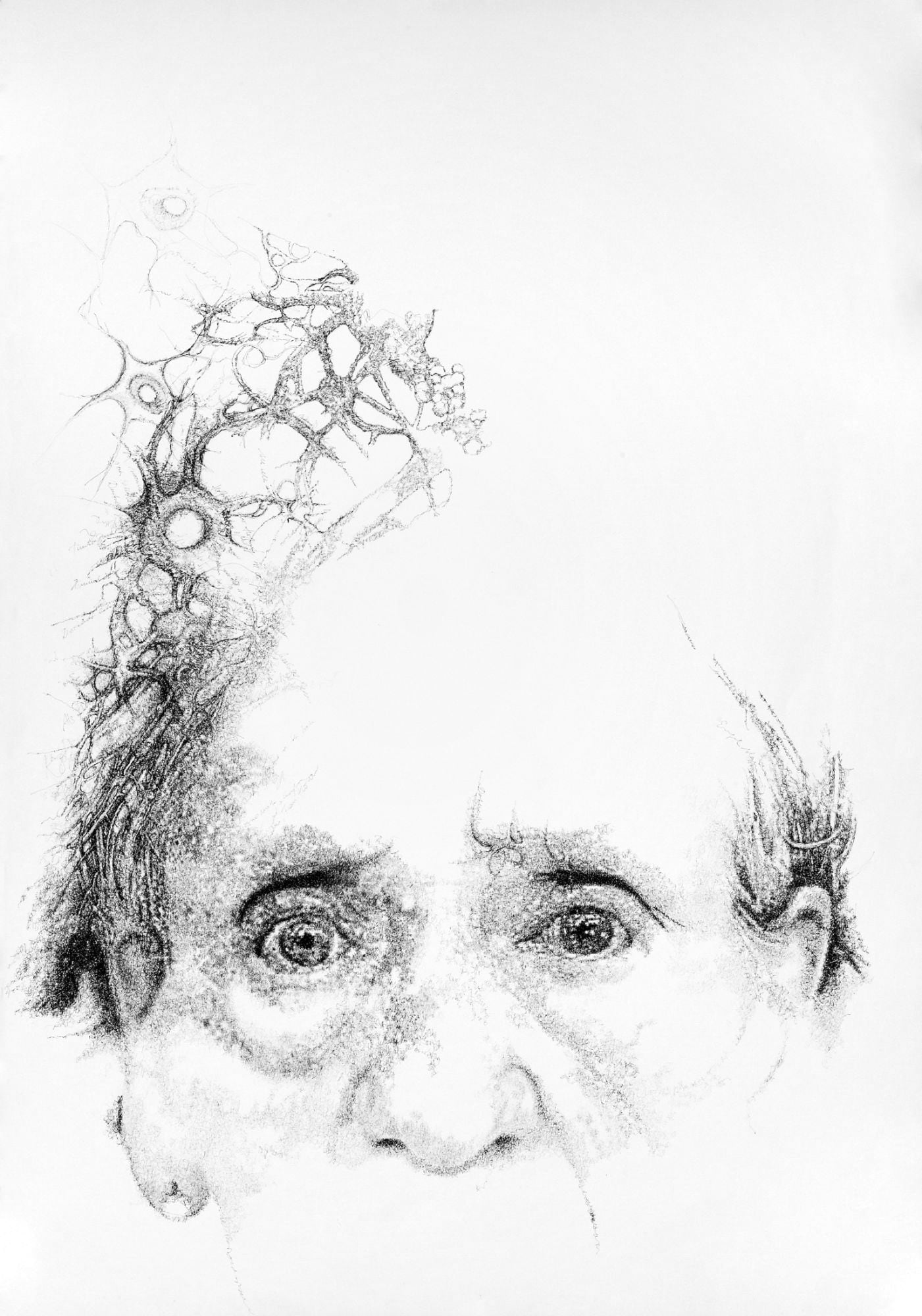
Drawing: two wide-open eyes in a face that is only hinted at, above them the head dissolving into a web of nerve cells

Blanc

2014

The gaze goes out into the void. The features mirror worry, vulnerability and grief, but the eyes are empty. The ink is applied with infinite delicacy; a fine curved line narrows into shadows and elsewhere dissolves into nothing.

Read more

The face of an Alzheimer’s patient with no name, unknown but familiar. The contours dissolve towards the edges, and where the centre of reason should be grows a web that leaves the cranium and develops an existence of its own, beyond human control. The observer’s glance is drawn again and again to the eyes, which now have nothing behind them that could explain the world in front of them.
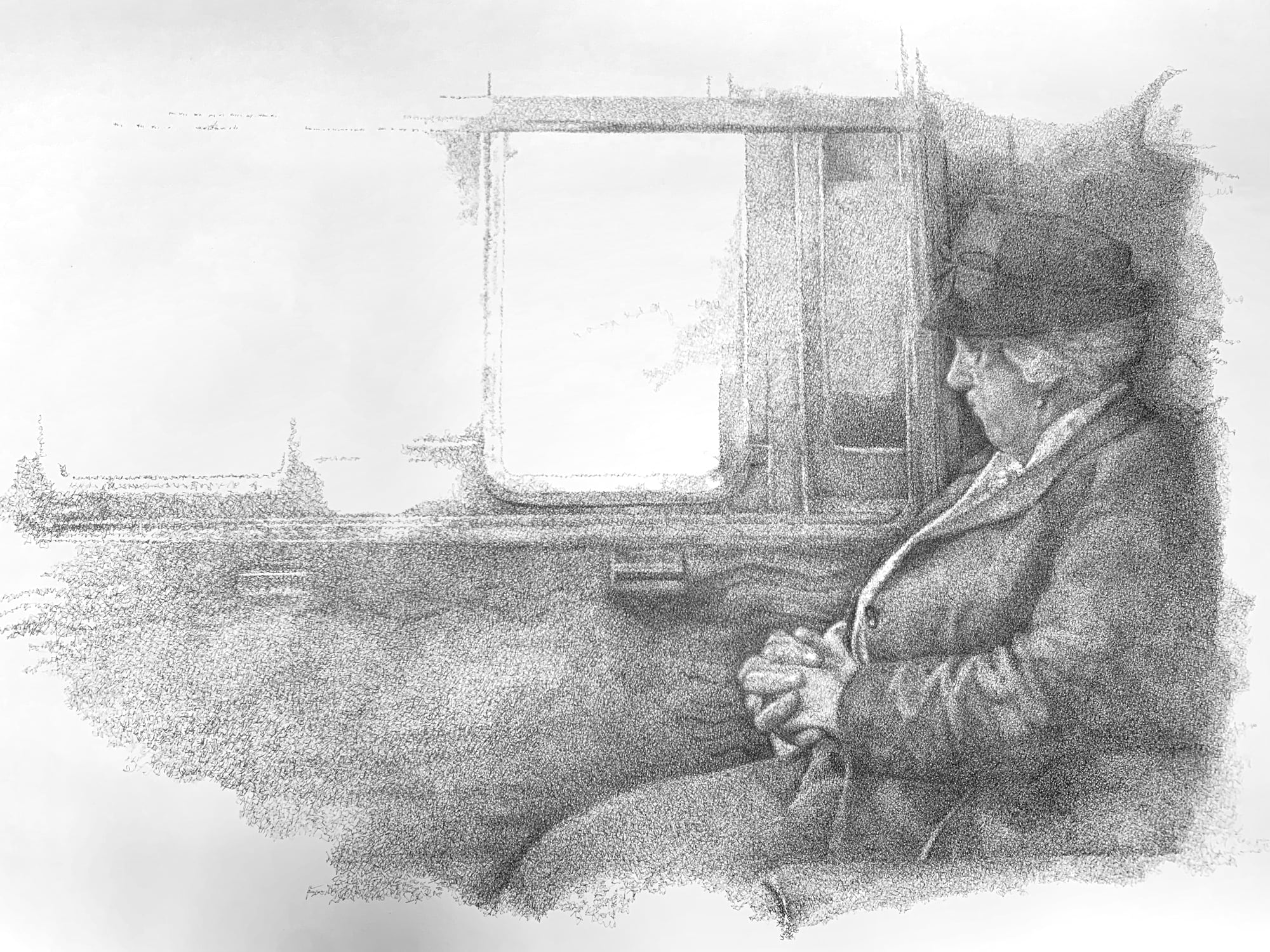
Drawing: Miss Marple sits in a train compartment, wearing a hat, hands folded, looking out of the window

4:50 from Paddington

On view in the original: exhibition in Cologne, Sunday, 15 November 2026

Ink on paper, 40 × 26 in (approx. 102 × 66 cm), 2014 · original, framed · giclée on request

Enquire about the originalOr enquire by email

A film still from “4:50 from Paddington” shows Miss Marple gazing out of a train window. In the film this is the defining moment: in a split second, the sharp and vigilant detective witnesses a murder on a passing train. But the view through the window is blank. Keen observation turns into an empty stare. Something happens so fast that the mind is not sure whether it really took place. Uncertainty replaces knowledge.

Read more

The actress Margaret Rutherford, who played Miss Marple, died in 1972 at the age of 80; she had Alzheimer’s.

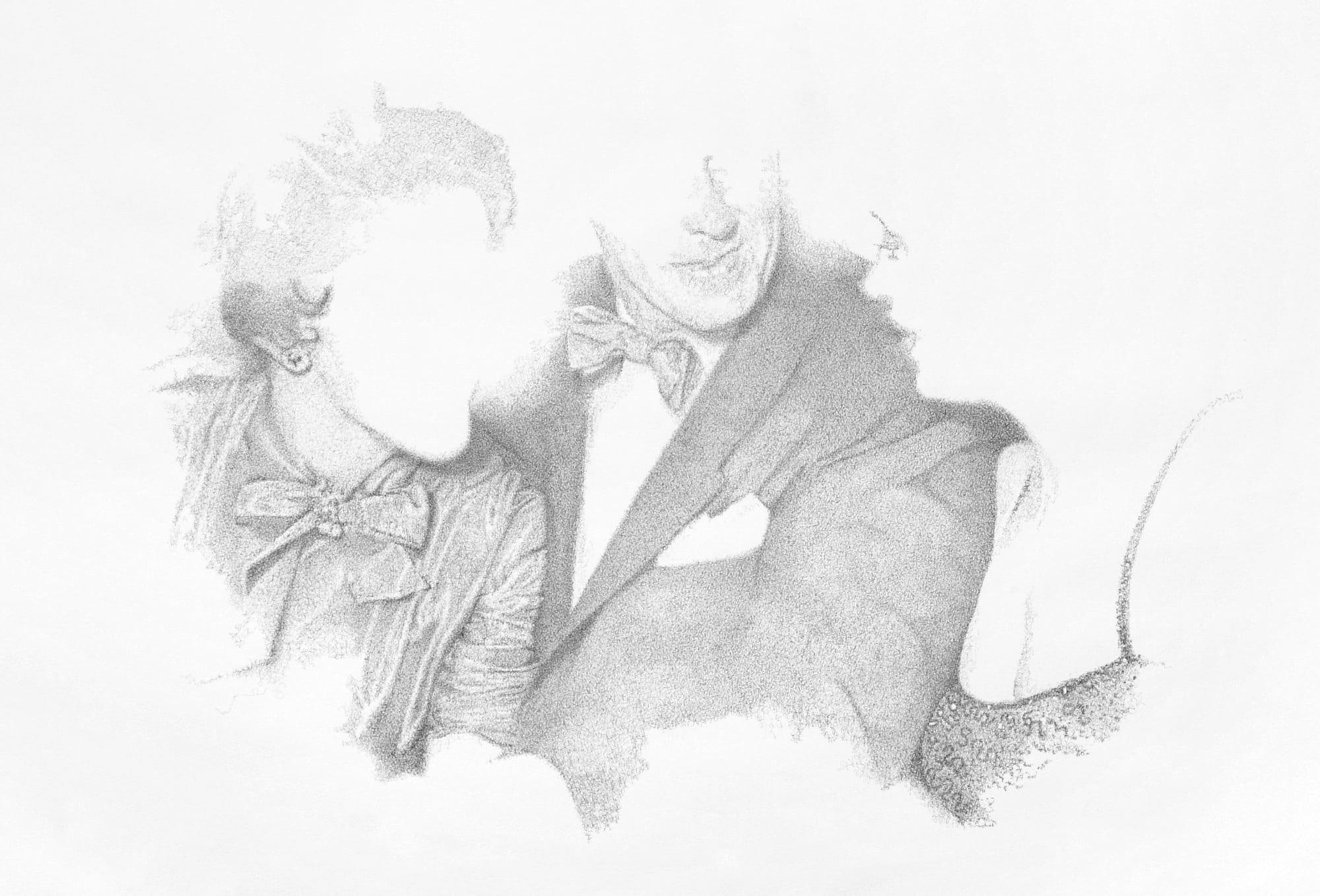
Drawing: a woman with a bow at her collar and a man in a dinner jacket and bow tie, both faces left white; on the right the arm of a third person in an evening dress

Unforgettable Moments

A moment he would have loved to remember: Ronald Reagan sitting between Nancy Reagan and Marilyn Monroe.

Ink on paper, 40 × 26 in (approx. 102 × 66 cm), 2014

Drawing on paper: private collection, Berlin · print on acrylic: private collection, Chicago

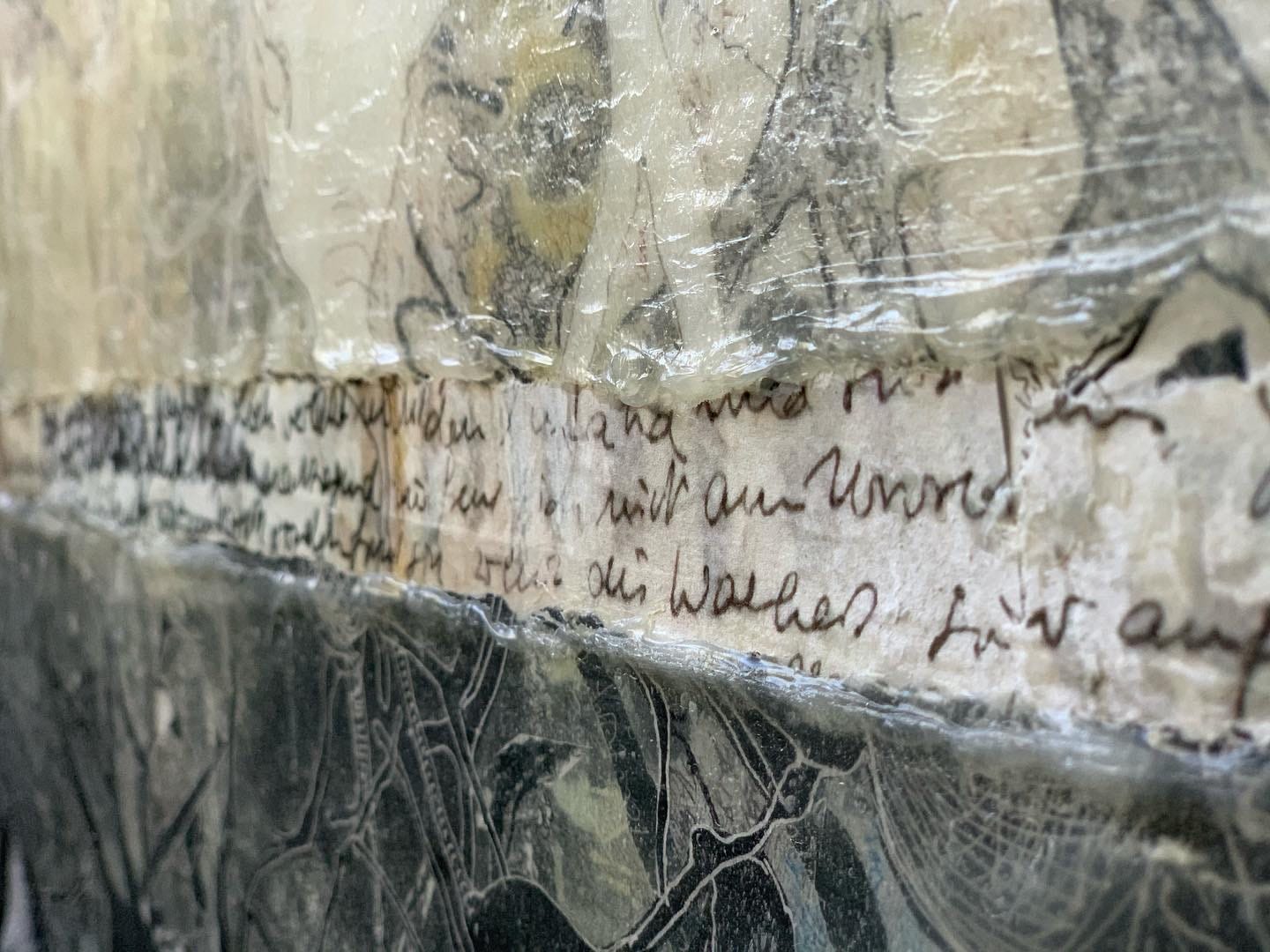
Close view of the collage: handwritten lines between drawings, covered by a glossy, rippled layer

Memoir I Am

The collage grew over several months: images, drawings, handwritten documents, passing ideas, poems and radio broadcasts, all pasted on top of one another and interlocked during that time. At the very end I coated the whole work with a gel paste and sealed it.

Collage · mixed media on found canvas, 110 × 120 cm (43 × 47 in)

Details of the collage and documents from the process

The display panels, 10 × 15 cm each, are photographed stages from the making of the collage. They show what has since been pasted over and can no longer be seen in the finished work.

Organic bodies overgrow the surface, expand and spin a net over everything that once was. In shades from white to black they send out neurons that look like tentacles. What began as a network becomes a diseased overgrowth that buries everything that lies beneath.

Read more

From deep below comes a diffuse glow, a hidden light. Mysteriously, shapes, faces, single letters, words and texts rise to the surface. Moments emerge like memories from the deep, and suddenly a single eye stares fiercely at the viewer. Countless impressions form what lies underneath. In many layers the density grows, the superposition, the unease and, with these, the darkness.

‘Memoir I Am’ itself becomes the anatomy of the disease that is the embodiment of obliteration. The piece examines the nature of Alzheimer’s and inquires into its course. It turns the inside out and explores the personal experience of losing oneself. Hopelessness becomes tangible. The darkness prevails, gains the upper hand and will drag everything with it in the end.

With its division into light and dark the piece becomes a diptych, a devotional picture. It tells the story of a world where light and shadow have been thrown out of joint. Emotions and values shift and switch sides. What remains are loss, desperation and confusion.

The surface is thick and pasted over. The disease lays itself like an impenetrable skin between the self and the world around. In the seam between the two spheres the ground opens, and there appears the word that was in the beginning. With it comes the insight that no thought can be taken back, and the notion of a power that brings light and hope into the dark.

Text: Sabine Hinrichs, PhD

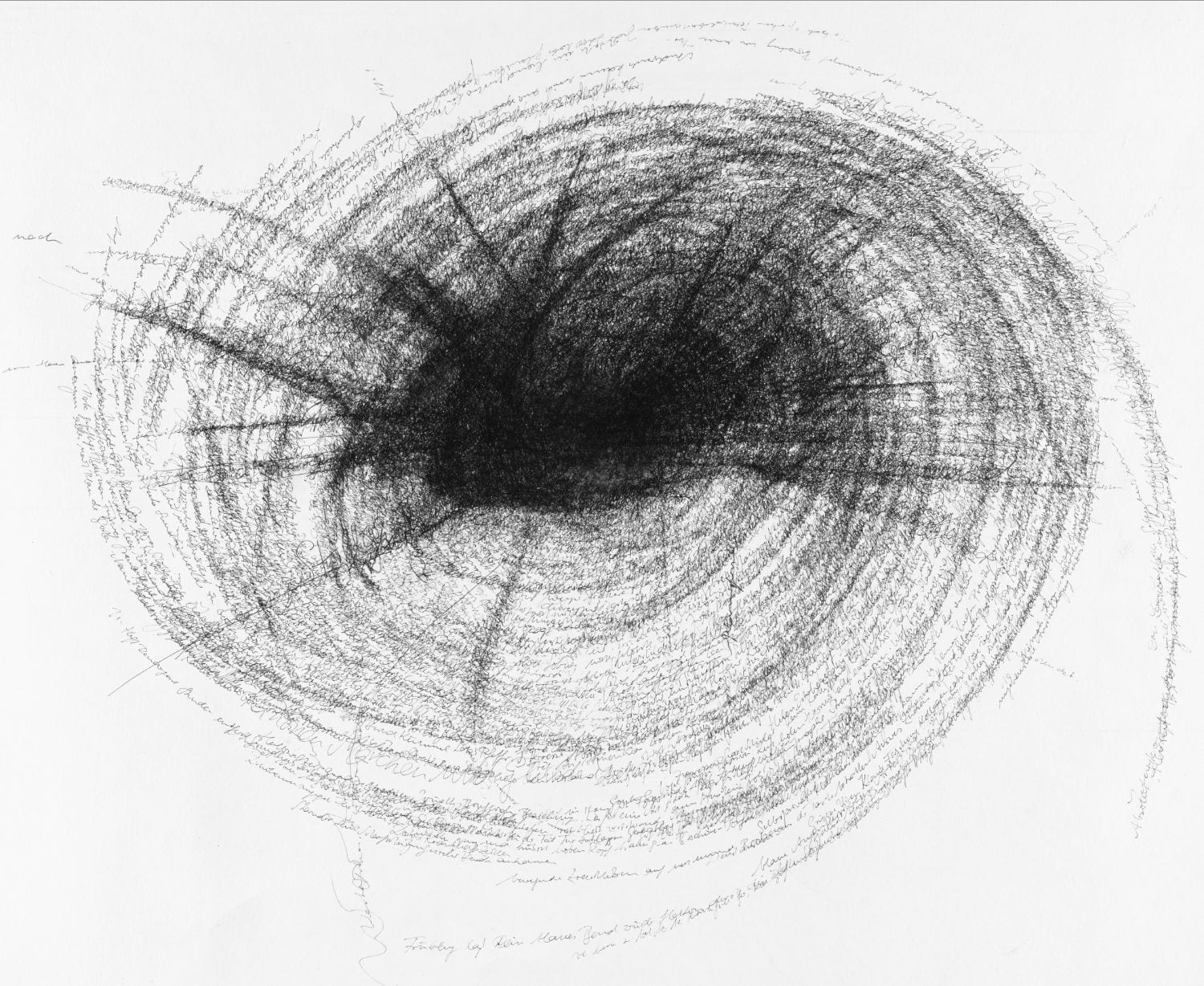
Drawing: handwritten lines circle in a spiral around a dark centre

Word Swirl

Private collection, Chicago

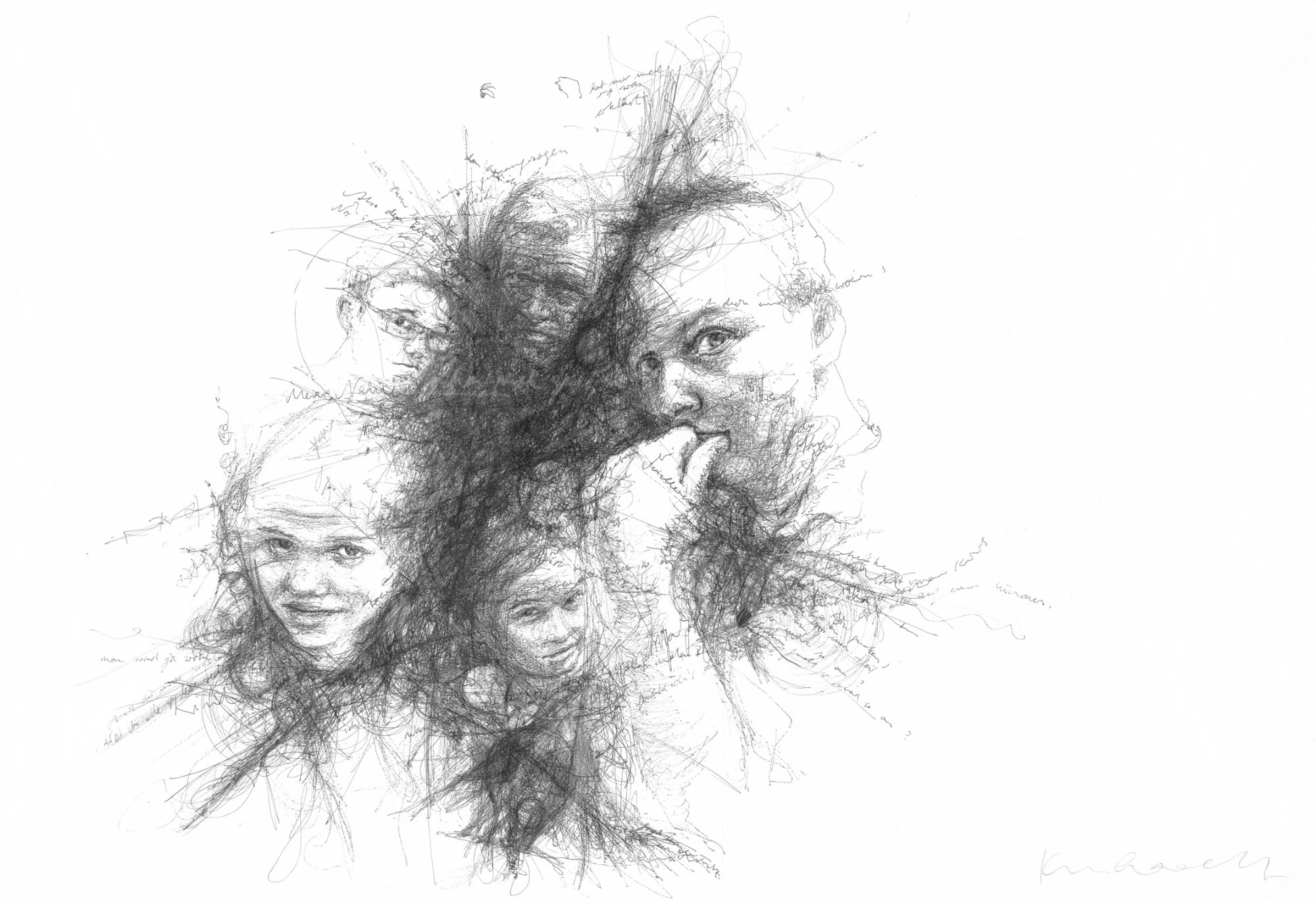
Drawing: four faces look at the viewer, connected and half covered by a dark tangle of lines and writing

What was I going to say?

Ink on Xerox, 40 × 26 in (approx. 102 × 66 cm), 2014

For ‘What was I going to say?’ the artist changes the vantage point. The viewer is not observing the patient but is put in her place. It depicts the moment when the words slip the mind, when a sentence has been begun and the thought that started it is no longer accessible.

Read more

You try hard to remember, and with every passing moment the situation gets more uncomfortable for both sides. The struggle of the speaker is mirrored in the faces that stare back. They display amusement, impatience, pity and doubt. An unsettling scene that is familiar to many, and the only hope is that the moment will pass.

On forgetting

Why did I turn to the subject of Alzheimer’s?

It began with my aunt Gabi, my father’s youngest sister. She was a teacher, a woman of words. She loved the German language, wordplay, riddles and poems. She knew song lyrics by heart and was a wonderful singer. Words were an essential part of who she was.

In her last years she had almost no access left to that world which had once shaped her so deeply. She has since died. It still moves me that the very thing that made her so unmistakable to me was what was lost.

Then there is my own preoccupation with forgetting: names, dates, memories that suddenly will not come. The illness in one’s own family makes one think about one’s own vulnerability, too. What can we do to preserve our memory? And what actually happens in our brain when memories and knowledge slowly disappear?

My curiosity led me to the nerve cells and their connections, an unimaginably complex network in which our perceptions, memories and knowledge are linked. Alzheimer’s gradually destroys these connections and nerve cells. The brain increasingly loses its ability to store and retrieve information.

More series